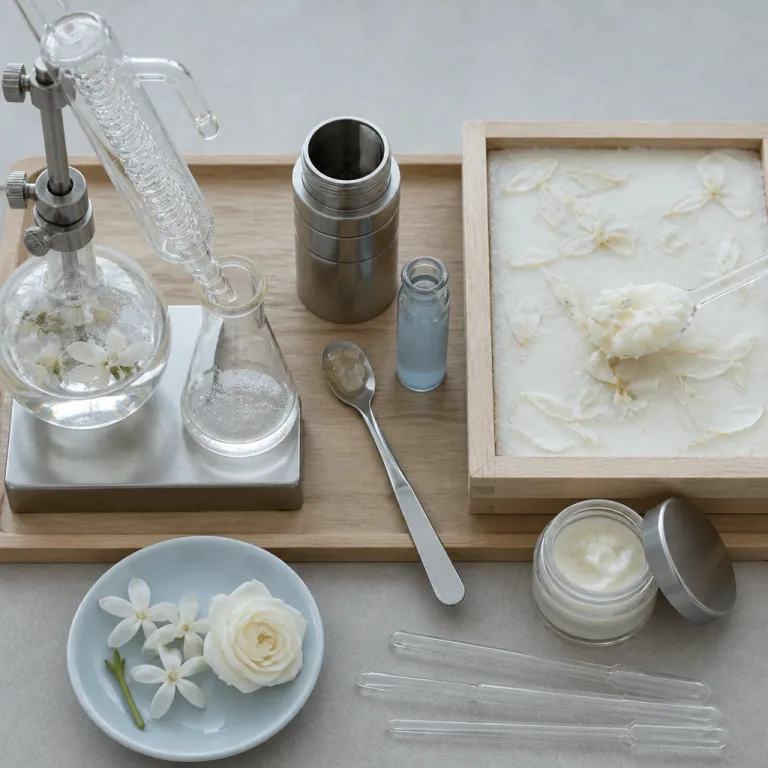
Why perfume extraction methods and distillation change the same flower
Stand in front of your perfume wardrobe and pick every rose. You will notice how each fragrance extraction feels like a different personality wearing the same dress, because every extraction method edits the aromatic story of the raw material. Understanding perfume extraction methods and distillation lets you read those edits on your skin and choose the version of a flower that matches your taste.
Perfumers start with plant materials such as rose petals, jasmine tuberose blossoms, orange blossom flowers, resins, woods, and citrus peels as their core raw materials. From there, they choose an extraction process — steam distillation, solvent extraction, supercritical fluid CO2, enfleurage, or headspace — based on which aromatic compounds they want to keep, and which they are willing to lose. Each extraction method creates a different balance of fragrant compounds, so the same plant material can yield several distinct oils, absolutes, or CO2 extracts that behave differently in a finished perfume.
Think of each process as a lens placed between the flower and your nose. Steam distillation gives a bright, volatile essential oil that emphasizes top notes and lighter aromatic facets while sacrificing some heavier compounds. Solvent extraction and CO2 supercritical fluid techniques pull a wider range of aromatic compounds from the plant materials, creating absolutes and CO2 extracts that feel denser, more textured, and often closer to the smell of the living flowers in the field.
Steam distillation and the clean clarity of essential oils
Steam distillation is the workhorse of perfume extraction, quietly filling drums with essential oils that anchor everything from niche attars to supermarket colognes. In this extraction method, steam passes through the plant material, lifts volatile aromatic compounds into a vapor, then condenses with water so the essential oil can be separated and collected. The process is efficient, relatively gentle, and ideal for large volumes of raw materials such as lavender, peppermint, eucalyptus, and many citrus peels.
Because steam distillation relies on heat and water, it favors lighter fragrant compounds and sacrifices some fragile top notes and heavier molecules that define the full scent of certain flowers. A steam distilled orange blossom essential oil, for example, smells fresher and more herbal than the lush, honeyed orange blossom absolute obtained by solvent extraction from the same plant materials. The same tension appears with jasmine tuberose type materials, where steam distillation struggles to capture the narcotic, creamy depth that solvent extraction or CO2 supercritical fluid methods preserve more faithfully.
For perfumers, the clarity of essential oils from steam distillation is both a strength and a limitation. These essential oils bring clean, linear fragrance effects and reliable performance in the formula, but they rarely reproduce the complete aromatic profile of the original flowers or raw material. When you smell a bright, almost soapy neroli note in a fragrance, you are often smelling the streamlined result of steam distillation rather than the more animalic, indolic complexity that a richer extraction process might reveal.
Steam distillation also shapes how top notes behave in the finished perfume. Citrus essential oils obtained by this method, or by cold pressing, give sparkling openings but can feel thinner than CO2 extracts that retain more of the fruit’s pithy, bitter aromatic compounds. When you read a review praising the “clean” character of a fragrance, there is usually a backbone of distilled essential oils behind that impression, quietly steering the composition away from the dirtier facets of the original plant materials.
In traditional production hubs from Grasse to Calabria, distillation equipment defines the rhythm of harvest season. Farmers bring in plant material at dawn, still wet with water from the fields, and the extraction process begins before the sun burns off the most volatile fragrant compounds. That industrial reality explains why steam distillation remains central to perfume extraction methods and distillation, even when more refined techniques exist for certain flowers.
When you explore a composition built around distilled materials, such as a neroli cologne or a lavender fougère, you are smelling the aesthetic of efficiency. The perfume is shaped by what steam distillation can carry over the water and what it inevitably leaves behind in the spent plant material. That gap between the essential oil and the living flower is where other extraction methods step in to complete the picture.
For a vivid example of how distilled materials behave inside a finished composition, look at any detailed breakdown of a perfume brief, such as an analysis of how a perfumer receives instructions to create a specific accord. Reading a technical discussion of the creative brief and raw materials, like the one on the structure of a perfumer’s brief, helps you connect the dots between extraction methods and the final fragrance on your skin.
Solvent extraction, absolutes, and the density of real flowers
Where steam distillation gives clarity, solvent extraction gives density and shadow. In this extraction process, a solvent such as hexane washes over the plant materials, dissolving both volatile aromatic compounds and heavier waxes, pigments, and non volatile fragrant compounds that water and steam cannot carry. The result is a waxy concrete that is then treated with alcohol to yield an absolute, a concentrated aromatic material that often smells closer to the living flowers than any essential oil.
Smell jasmine absolute next to jasmine essential oil and the difference is immediate. The essential oil, usually obtained by a form of steam distillation or fractionation, feels lighter and more transparent, while the absolute from solvent extraction carries the full indolic, almost animalic breath of jasmine tuberose style white flowers. The same holds for orange blossom absolute, which smells deeper, more honeyed, and more leathery than the brighter, greener neroli essential oil obtained from distillation of the same raw material.
Absolutes also change how top notes and base notes interact in a perfume. Because solvent extraction pulls heavier aromatic compounds from the plant material, an absolute often bridges the gap between the fleeting sparkle of distilled essential oils and the long lasting base of resins, woods, and musks. In a complex oriental composition built around orange blossom and jasmine tuberose, the perfumer might use both essential oils and absolutes to control how the fragrance opens, blooms, and finally settles into the skin.
Solvent extraction is not limited to flowers. It is used for delicate plant materials such as mimosa, narcissus, and osmanthus, as well as for resins like labdanum and benzoin that resist steam distillation. Each raw material responds differently to the extraction method, so perfumers often test several extraction methods before choosing the one that gives the most useful aromatic profile for a specific fragrance. That is why two perfumes built around the same named note can smell unrelated, even when they share the same botanical origin.
For the wearer, the presence of an absolute usually signals a richer, more textured experience. When you read a note list that specifies jasmine absolute, orange blossom absolute, or tuberose absolute, expect more of the flower’s nocturnal, almost humid facets rather than the airy brightness of a distilled essential oil. This difference becomes especially clear in dense, atmospheric compositions that explore desert, tea, or leather themes, where absolutes provide the thick, almost tactile floral heart that supports spices and woods, as seen in detailed analyses of deep tea and desert inspired fragrances such as a red tea desert composition.
Solvent extraction does have trade offs, including traces of solvent and higher cost, which is why not every floral perfume leans on absolutes. Yet for connoisseurs who crave the full, breathing presence of flowers, absolutes remain some of the most prized materials in the perfumer’s palette. They are the closest you can get, in bottled form, to burying your face in a handful of freshly cut blossoms at midnight.
When you evaluate a fragrance that claims to showcase a specific flower, ask yourself which version of that flower you are smelling. Is it the streamlined clarity of an essential oil from distillation, or the velvety density of an absolute from solvent extraction ? That simple question often explains why one perfume feels like a watercolor sketch while another feels like an oil painting of the same botanical subject.
Understanding how absolutes behave also helps decode concentration labels on your bottle. A fragrance that leans heavily on dense absolutes will feel more saturated even at a lower concentration, while a composition built mostly on distilled essential oils may need a higher dosage to achieve the same impact, a nuance explored in depth in guides to what concentration labels really mean.
CO2 supercritical extraction, enfleurage, and the ghost of the living flower
CO2 supercritical extraction sits between distillation and solvent extraction, borrowing the best of both. In this extraction method, carbon dioxide is turned into a supercritical fluid under high pressure, allowing it to penetrate plant materials like a gas while dissolving aromatic compounds like a liquid. When the pressure drops, the CO2 returns to a gas and leaves behind a concentrated extract that often smells startlingly close to the raw material.
Because CO2 extraction uses no water and minimal heat, it preserves delicate top notes and heavier aromatic compounds that steam distillation can damage. A CO2 extract of ginger, for example, captures both the bright, citrusy facets and the warm, spicy depth in a way that distilled ginger essential oil rarely matches. The same holds for CO2 extracts of spices, woods, and even some flowers, where the resulting material feels more three dimensional than either an essential oil or an absolute from solvent extraction.
For fragrance lovers, CO2 supercritical fluid extracts often read as more naturalistic, especially in compositions that aim to recreate specific landscapes or culinary accords. A tea note built with CO2 extracts of black tea and spices will feel more textured and realistic than one built only from distilled essential oils and synthetic aroma chemicals. This is where the main SEO keyword, perfume extraction methods distillation, intersects with modern niche perfumery, because CO2 extraction expands what perfumers can express without abandoning traditional distillation techniques.
Enfleurage, by contrast, is almost entirely historical yet still haunts the way we talk about flowers in perfume. In this slow extraction process, fresh flowers are placed on trays of fat, traditionally animal fat or sometimes coconut oil, which absorbs their aromatic compounds over days before being washed with alcohol to yield an absolute. The method is labor intensive and requires vast quantities of plant material, which is why commercial enfleurage has largely disappeared, but its reputation for capturing the truest scent of fragile flowers such as jasmine tuberose and orange blossom remains legendary.
Smell a rare jasmine enfleurage absolute next to a modern solvent extracted jasmine absolute and you will notice a difference in texture. The enfleurage material often feels softer, more rounded, with a creamy, almost skin like quality from the fat or coconut oil used as the initial absorbing material. While CO2 extraction and solvent extraction can capture more of the aromatic compounds present in the plant material, enfleurage seems to translate the emotional aura of the living flowers in a way that fascinates collectors and artisans.
Both CO2 extraction and enfleurage remind us that the extraction process is not neutral. Each technique filters the raw material through a different physical reality — pressure, fat, water, solvent — and the resulting fragrance materials carry those histories into the perfume. When you read about a niche house using CO2 extracts of rare plant materials or reviving small scale enfleurage for orange blossom, you are seeing a deliberate aesthetic choice, not just a technical one.
For the wearer, this means that two perfumes built around the same named note can feel worlds apart because one leans on distilled essential oils while the other leans on CO2 extracts or enfleurage absolutes. A tuberose built on CO2 and enfleurage materials will feel more like a humid, breathing flower, while a tuberose built on distilled fractions and synthetics will feel more sculpted, almost abstract. Both approaches have merit, but they tell different stories about what a flower can be in fragrance.
As you explore your collection, start noticing when a perfume lists CO2 extracts, absolutes, or rare enfleurage materials in its composition. Those details explain why certain fragrances feel unusually lifelike, as if the flowers were still attached to the plant, while others feel like stylized interpretations shaped by the constraints of distillation and solvent extraction. The method is not a footnote ; it is part of the artistic statement.
From raw material to finished perfume: how extraction shapes what you smell
Every finished perfume is a negotiation between raw materials, extraction methods, and the perfumer’s intent. A rose accord might blend steam distilled rose essential oil for brightness, rose absolute from solvent extraction for depth, and perhaps a CO2 extract for a dewy, realistic petal effect, each material carrying different aromatic compounds from the same plant. The extraction process determines which fragrant compounds are available to the perfumer, and therefore which facets of the flower can appear as top notes, heart notes, or base notes on your skin.
When you see essential oils listed in a formula, you can expect a certain transparency and volatility. Essential oil materials from distillation tend to dominate the opening of a fragrance, delivering that first rush of citrus, herbs, or light florals before yielding to the denser absolutes and resins extracted by solvents or CO2. This is why a perfume that leans heavily on distilled essential oils often feels more cologne like, while one built on absolutes and CO2 extracts feels more like a parfum, even before you look at the concentration label.
Perfume extraction and fragrance extraction also influence how a composition ages in the bottle. Distilled essential oils can oxidize faster, especially citrus oils, gradually muting the top notes and shifting the balance toward the heart and base. Absolutes and CO2 extracts, with their heavier aromatic compounds, often age more gracefully, sometimes gaining a subtle patina that collectors appreciate in vintage perfumes built around orange blossom, jasmine tuberose, and other rich floral materials.
For connoisseurs, reading between the lines of a note list becomes a kind of sport. If a brand mentions “rose absolute” and “rose essential oil” separately, you know they are layering different extraction methods to sculpt the floral profile. If they highlight CO2 extracts of spices or woods, you can anticipate a more realistic, textured effect than if they relied solely on distilled essential oils or synthetic aroma chemicals to build the same accord.
Extraction methods also shape how a perfume interacts with your skin. Materials obtained by solvent extraction or CO2 often cling longer, contributing to the fragrance’s longevity and the richness of the drydown. Distilled essential oils, especially from citrus and herbs, may flash quickly but leave a clean, diffusive halo that influences how you and others perceive the overall fragrance, even after the obvious top notes have faded.
When evaluating a new release, ask not only what flowers or woods it claims to feature, but also how those materials were obtained. A tuberose built on absolute and CO2 extract will likely feel creamier and more narcotic than one built on distilled fractions and synthetics, even if both list “tuberose” in the official pyramid. That awareness turns you from a passive consumer into an informed participant in the creative process, able to connect the dots between extraction, distillation, and the story unfolding on your skin.
Ultimately, perfume extraction methods and distillation are not just technical footnotes for industry insiders. They are the invisible architecture behind every fragrant experience you love, from the first citrus sparkle to the last whisper of woods and musk at midnight. Once you start paying attention to how extraction shapes what you smell, you will never read a note list the same way again.
How to read labels and note lists through the lens of extraction
Most perfume bottles do not list every extraction method used, but they leave clues. When a brand specifies essential oil, absolute, CO2 extract, or even rare enfleurage materials in its communication, it is signaling both quality and a particular aesthetic choice. Learning to decode those signals helps you predict how a fragrance will behave before you spray it on your skin.
If you see “lavender essential oil” or “orange blossom essential oil” mentioned, expect the streamlined clarity of steam distillation. These distilled essential oils will likely dominate the top notes and early heart, giving a bright, clean impression that may feel more abstract than the smell of the raw material in nature. When the same perfume also lists orange blossom absolute or jasmine absolute, you can anticipate a transition from that distilled freshness into a denser, more sensual floral core shaped by solvent extraction.
Mentions of CO2 extracts or supercritical fluid techniques usually appear in more technical descriptions aimed at enthusiasts. A label that highlights CO2 extracts of spices, woods, or even delicate flowers is telling you that the perfumer wanted a more realistic, textured representation of those raw materials than distillation or classic solvent extraction alone could provide. This is especially relevant in modern niche compositions that aim to recreate specific environments, from tea ceremonies to desert landscapes, where the nuance of the plant materials matters as much as the overall accord.
Enfleurage is rarely used at scale today, so any reference to it should catch your attention. A perfume that includes jasmine or orange blossom enfleurage is almost certainly produced in small quantities, with a focus on artisanal craftsmanship and a desire to capture the most faithful possible impression of the living flowers. For collectors, these materials offer a glimpse into historical perfume extraction practices, where coconut oil or animal fat once served as the absorbing medium for the most delicate blooms.
When brands are less transparent, you can still infer a lot from how a fragrance smells and behaves. A very bright, short lived citrus opening suggests distilled essential oils, while a long lasting, almost chewy floral heart points toward absolutes and possibly CO2 extracts. If a white floral feels creamy, skin like, and unusually close to the scent of fresh jasmine tuberose blossoms, there is a good chance that richer extraction methods were involved, even if the marketing copy stays vague.
For those who adore fragrance, paying attention to extraction methods turns casual smelling into informed appreciation. You start to recognize the signature of steam distillation in classic colognes, the weight of absolutes in vintage style florals, and the lifelike realism of CO2 extracts in contemporary niche creations. The flower on the label is only half the story ; the way its aromatic compounds were coaxed from the plant material is what truly shapes the perfume you fall in love with.
FAQ: perfume extraction methods and distillation
Why do two perfumes with the same flower smell completely different ?
Two perfumes built around the same flower can smell different because they use different extraction methods and different fractions of the same raw material. One fragrance might rely on steam distilled essential oil, which emphasizes lighter, fresher facets, while another uses an absolute or CO2 extract that captures heavier, more sensual aromatic compounds. The perfumer’s blending choices then amplify or soften these differences, leading to distinct interpretations of the same botanical source.
Is an absolute always better than an essential oil in perfume ?
An absolute is not automatically better than an essential oil ; it is simply different. Absolutes from solvent extraction usually smell richer and closer to the living flowers, but they can be heavier and more expensive, which may not suit every style of perfume. Essential oils from distillation offer clarity and brightness, making them ideal for fresher compositions where transparency and lift are more important than density.
What is the advantage of CO2 supercritical extraction in perfumery ?
CO2 supercritical extraction allows perfumers to capture a wide range of aromatic compounds without using high heat or traditional solvents. This often produces extracts that smell very close to the raw material, with both bright top notes and deeper facets intact. For fragrance lovers, CO2 extracts can deliver more realistic, textured impressions of spices, woods, and some florals compared to classic distilled essential oils.
Why is enfleurage rarely used in modern perfume production ?
Enfleurage is rarely used today because it is extremely labor intensive and requires large amounts of fresh flowers and fat or coconut oil. The process is slow and costly compared to steam distillation, solvent extraction, or CO2 methods, which can handle higher volumes of plant materials more efficiently. As a result, enfleurage survives mainly in small artisanal projects and historical reconstructions rather than mainstream commercial perfumery.
How can I tell which extraction methods were used in my perfume ?
Most bottles do not list extraction methods directly, but brand descriptions, technical sheets, and interviews with perfumers sometimes mention essential oils, absolutes, CO2 extracts, or enfleurage. You can also infer clues from how the fragrance smells and behaves, such as the brightness and volatility of the top notes or the density of the floral heart. Over time, training your nose on single materials from different extraction methods will make it easier to recognize their signatures inside finished perfumes.