Start with your life, not the bottle: mapping everyday pleasures to fragrance families
Before asking how to choose a perfume, look at your laundry basket. The fabric softener, your favourite candles and even the way your kitchen smells after cooking already hint at the fragrance families your nose secretly loves. This quiet audit of daily pleasures gives you a first scent profile that feels personal rather than dictated by a sales pitch.
If your home leans toward clean cotton, citrus cleaners and airy linen sprays, you probably enjoy fragrances with bright top notes and transparent eau de parfum textures. People who burn vanilla candles, crave desserts and reach for almond body oils often gravitate to gourmand perfume notes and creamy base notes that feel almost edible. Fans of pine forests, herbal teas and walks after rain usually end up choosing perfumes built around woods, moss and natural oils that echo the outdoors.
Translate these clues into concrete fragrance families when you next choose perfume at a counter. Clean and citrus-leaning people often enjoy cologne-style eaux or light eau parfum blends with sparkling top notes of bergamot, lemon or petitgrain. If you love spices in food, incense in churches or smoky tea, your future signature scent may sit in the oriental, amber or oud families, where heart notes of resins and spices slowly melt into long-lasting base notes on the skin.
Think about your body products as well, because they already layer scent on your skin type every day. A shea butter body cream with coconut and vanilla will nudge any parfum you wear toward warmth and sweetness, while a gel with eucalyptus and mint keeps fragrances feeling brisk and cool. When you start choosing perfume with this context in mind, you are not just selecting perfume randomly; you are curating a collection that respects your real life and your real body chemistry.
Even your morning coffee order can guide how to choose a perfume that belongs to you. Black coffee drinkers often enjoy sharper, drier scents with aromatic notes and woods, while those who love caramel lattes tend to favour rounder perfumes with soft heart notes of tonka, praline or milky sandalwood. The more honestly you map these cravings, the easier finding a signature becomes, because you are no longer chasing trends but translating your own habits into scent.
From strip to skin: a testing ritual that respects body chemistry
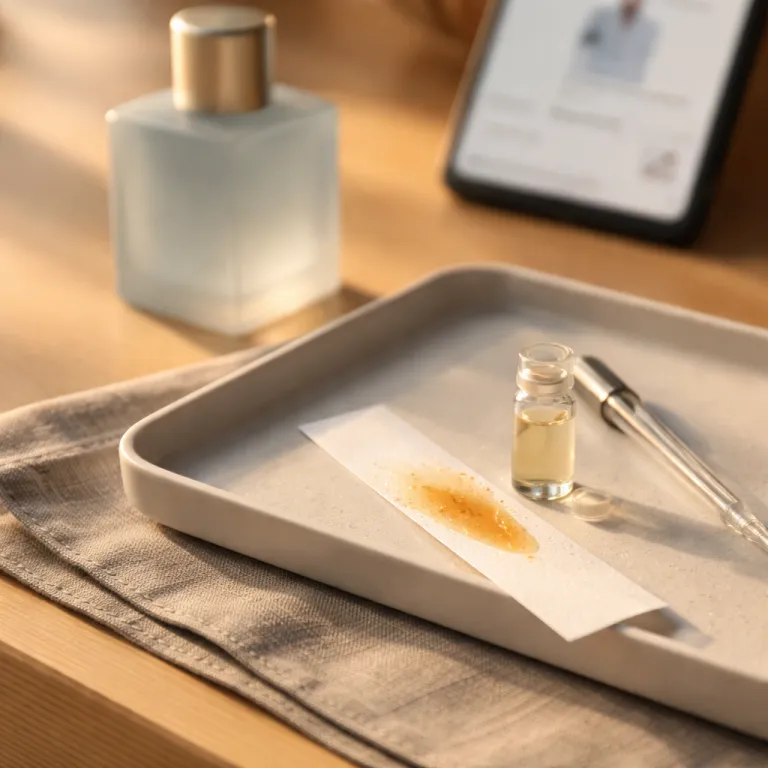
Most people fail at choosing perfume because they stop at the paper blotter. A strip can show you the basic perfume notes, but it ignores how your skin, your natural oils and your body chemistry will twist those notes over hours. If you want a signature scent that feels like you, you must graduate from strip sniffing to a disciplined skin test.
Use a simple, numbered testing checklist whenever you explore new scents:
- Smell no more than five or six perfumes on paper to narrow down options.
- Choose up to three favourites and spray each perfume once on clean, bare skin, with at least 5 cm between each patch.
- Apply the 30-minute rule: smell the fresh spray once, then ignore it while you walk, shop or answer emails.
- Return after about 20–30 minutes to judge the heart notes, then again after two hours to assess the base notes and lasting power.
- Repeat this process on at least three different days and in different situations before deciding to buy.
On the strip, you mainly smell the top notes, which are the volatile molecules that vanish within minutes. On your wrist, you will meet the heart notes after about 20 minutes, then the base notes that cling to the skin for the rest of the day. A refined composition with layered woods, aromatics and resins only makes sense when you follow it through all three stages.
Pay attention to how your skin type alters the ride from top to base. Oily skin tends to amplify sweetness and make scents feel more intense, while dry skin can swallow delicate perfume notes and shorten their long-lasting potential. If your skin is very dry, use an unscented body cream or neutral natural oils first, then spray the perfume on top; this simple step can transform a fleeting eau into a fragrance that finally lasts.
Skin type, climate and the quiet science of lasting power
How to choose a perfume that behaves in real life means thinking beyond the bottle and into climate. The same fragrance will feel different in a cool office, a humid summer street or a heated bar at midnight, because temperature and humidity change how quickly perfume notes evaporate from the skin. Your skin type then adds another layer of complexity that you can either ignore or master.
If you have oily skin, you already carry more natural oils on the surface, which helps trap scent molecules and often makes fragrances feel more long lasting. On this kind of skin, dense oud perfumes, heavy ambers or rich eau parfum formulas can become overwhelming, so you might prefer cleaner scents, airy citrus or transparent florals for everyday wear. People with dry skin face the opposite problem, because the lack of oil means perfume can vanish quickly unless you prepare the body properly.
For dry skin, think of fragrance as the final layer in a care ritual. Start with a hydrating, unscented lotion, then add a thin film of neutral body oils before spraying your chosen parfum or eau parfum on top. This sandwich of moisture and natural oils gives the base notes something to cling to, turning a shy scent into a more confident signature.
Season also matters when selecting perfume for a wardrobe rather than a single bottle. In cooler months, your skin is colder and evaporation slows, so you can enjoy deeper scents with smoky woods, leather, incense or oud without suffocating the room. In heat and humidity, the same fragrances can bloom too fast, so many people choose perfume with lighter top notes, sheer musks and breezy florals that feel almost like a clean second skin.
Think of your collection as a set of tools rather than trophies on a shelf. A luminous woody blend might be perfect for evening walks, while a crisp citrus eau suits office hours. When you align fragrance families with your skin type, your local climate and the time of day, you stop fighting your perfumes and start letting them work with your body chemistry.
Sampling without regret: a strategy for testing, budgets and online orders
Standing at a counter can feel overwhelming, and online shopping adds another layer of doubt to how to choose a perfume. The solution is a sampling strategy that treats each trial as a small experiment rather than an impulse buy. When you approach selecting perfume like this, you protect both your nose and your budget.
Begin by defining a narrow target within the wider fragrance families you already enjoy. If you know you like clean musks and soft florals, ask for three samples that share similar heart notes but differ in base notes, such as one with woods, one with amber and one with musk. This lets you feel how different structures behave on your skin without scattering your attention across unrelated scents.
Online, look for curated discovery sets from specialist retailers, and think in terms of cost per trial rather than the full bottle price. A box of five eau parfum vials of 1–2 ml each might cost the same as a single cinema ticket, yet give you 15–25 full wear tests if you use one or two sprays per day. Keep a simple notebook or notes app where you record the perfume name, the time of application, your skin type that day and how long the scent felt truly long lasting on your body.
To make this concrete, you might try a mixed floral discovery set that includes a classic rose eau de parfum, a modern white floral with clean musk and a soft iris skin scent, or a woody sampler that contrasts a dry vetiver, a creamy sandalwood and a smoky amber. Sets like these help you compare structures side by side and quickly see which perfume notes consistently feel like you.
When choosing perfume as a gift, the stakes feel even higher, especially if you are ordering online. Use guides that focus on personality and existing habits rather than vague stereotypes, paying attention to the recipient’s current body products, favourite drinks and home fragrances. The same logic applies when you choose perfume for yourself; you are not buying an abstract scent, you are matching a real person with a real bottle.
Give every candidate at least three full wearings before deciding whether it deserves a place in your collection. The first day shows you the top notes and the thrill of novelty, the second reveals how the heart notes behave in different weather, and the third tells you whether the base notes and your body chemistry can coexist peacefully. If, after this three-wearing rule, you still reach for the vial instinctively, you are probably close to finding a signature that will earn its space on your shelf.
Reading a perfume like a story: notes, structure and your signature
Every fragrance is built like a three-act play, and learning to read that structure is the most reliable way to answer how to choose a perfume that feels intentional. The top notes are the opening scene, bright and fleeting, the heart notes carry the emotional core, and the base notes are the final image that lingers on the skin. Once you understand this, you stop chasing only the first five minutes of a scent.
When you study perfume notes on a brand website or a box, treat them as a map, not a promise. Citrus, herbs and some fruits usually sit in the top, florals and spices often occupy the heart, while woods, resins, musks and oud tend to anchor the base. If you hate how patchouli smells on your body, for example, you will want to avoid compositions where patchouli appears in the base notes, even if the top notes sound tempting.
Fragrance families give you a helpful shorthand for this architecture. A floral fragrance might pair rose and jasmine in the heart notes with a clean musk base, while a woody scent could combine cedar, vetiver and sandalwood over a smoky amber foundation. Gourmand perfumes lean on edible notes such as vanilla, caramel or coffee, often wrapped in soft musks that make them feel like a second skin for everyday wear.
As you keep testing, patterns will emerge in your preferences, and this is where finding a signature becomes realistic. Perhaps you notice that you enjoy scents where the top notes are citrus, the heart notes are white flowers and the base notes are woods, regardless of brand or price. That pattern is your personal scent profile, and it should guide you whenever you are choosing perfume in a new city, at duty free or on a website you have never used before.
Remember that a signature scent does not have to be a single bottle; it can be a small, coherent collection that expresses different moods while sharing a common thread. One parfum might be your intimate skin scent for quiet days, another eau parfum your polished office choice, and a deeper oud or amber your evening statement. What matters is that each bottle respects your skin, your body chemistry and the story you want your fragrance to tell.
Matching perfume to lifestyle: everyday wear, occasions and the three wearing rule
How to choose a perfume that actually belongs to you also means matching it to the life you live, not the fantasy in the advert. A scent that feels thrilling in a dim boutique can become oppressive in an open-plan office or vanish in a crowded bar. Thinking in terms of context will save you from many disappointing bottles.
Start by defining roles for your fragrances, just as you do for clothes. You might want one clean, understated eau parfum for everyday wear, one slightly louder parfum for dinners and events, and one comforting skin scent for home. This small but focused collection will serve you better than a chaotic shelf of perfumes that never quite fit the moment.
When selecting perfume for work, prioritise comfort and projection over drama. Look for scents with soft musks, gentle woods and discreet florals that sit close to the skin, avoiding heavy oud or syrupy gourmands that can dominate shared spaces. For evenings, you can lean into richer base notes, denser resins and more assertive heart notes, because the lower light and shorter distance between people can handle more intensity.
The three-wearing rule becomes crucial here, because context changes everything. A perfume that feels perfect on a quiet Sunday might feel cloying on a hot commute, so test each candidate in at least two different situations before committing. Wear it once to work, once on a relaxed day off and once in the evening, then ask yourself whether the scent profile still feels like your signature in all three settings.
Over time, you will notice that some fragrances become extensions of your body, while others remain costumes you rarely reach for. The former are your true signature scents, the ones that harmonise with your skin type, your body chemistry and your daily rituals. When you choose perfume with this level of honesty, you end up with fewer bottles but more joy every time you spray.
Clean, natural, oud: cutting through marketing to choose what really suits you
Modern perfume marketing loves big words such as clean, natural and oud, and they can easily confuse anyone trying to learn how to choose a perfume with confidence. Clean fragrance usually refers to a style of scent profile that feels airy, soapy or laundry-fresh, not necessarily to an ingredient list free from synthetics. Natural perfumes, on the other hand, rely heavily on essential oils and natural extracts, which can be beautiful but also less stable on the skin.
If you are drawn to natural scents, remember that essential oils are powerful materials that interact strongly with body chemistry. A natural rose parfum might smell luminous on one person and sharp on another, depending on skin type, pH and even diet. Always patch test natural oils and natural perfumes on a small area of skin first, especially if you have sensitive or dry skin that can react more easily.
Oud deserves special mention, because it has become a buzzword across many fragrance families. True oud oil is a dense, resinous material with a complex scent that can feel leathery, smoky or even slightly animalic, and it often dominates the base notes of a composition. Many modern oud perfumes use accords that imitate this effect, blending woods, resins and musks to create an oud-like impression that is easier to wear for everyday wear.
When choosing perfume in this crowded landscape, ignore the front label and go straight to how the scent behaves on your body. Ask how long lasting it feels on your skin, whether the heart notes stay pleasant after several hours and whether the base notes align with your idea of a signature scent. A so-called clean eau parfum that vanishes in an hour may be less useful to you than a more conventional fragrance that quietly lasts all day.
In the end, the only real test of any perfume, whether marketed as natural, clean or oud-heavy, is how it makes you feel from first spray to final whisper. If it harmonises with your skin type, respects your body chemistry and fits your lifestyle, it earns its place in your collection. The rest is just noise in the air, gone long before the scent on your wrist at midnight.
Key figures that shape how people choose perfume today
- Global fragrance sales exceeded 50 billion euros in 2022, reflecting a steady rise in consumers treating perfume as an everyday accessory rather than an occasional luxury, according to Euromonitor International’s global report “Beauty and Personal Care 2023” (see euromonitor.com for the published summary).
- Online fragrance purchases now represent more than 25% of total perfume sales in several major markets, which makes reliable sampling strategies and clear note descriptions more important than ever; this share is reported in Circana (formerly NPD Group) “Fragrance Consumer Report 2022” for the US and Western Europe (overview available via circana.com).
- Surveys from large retailers show that around 60% of buyers say they are searching for a signature scent, yet more than half of them own at least five bottles, highlighting the gap between impulse buying and intentional choosing; these figures echo findings from Euromonitor’s “Fragrance Usage and Attitudes 2021” study.
- Consumer research indicates that fragrances described with clear top, heart and base notes see higher repeat purchase rates, suggesting that education around perfume structure directly improves satisfaction, as reported in Circana’s “Premium Fragrance: Drivers of Loyalty 2021”.
- Market analyses report that interest in oud and wood-based perfumes has grown by double digits over the past decade, especially in unisex launches, showing a shift away from strictly gendered fragrance families, according to Euromonitor’s “Premium Fragrances: Global Trends and Forecasts 2020–2025”.
FAQ: how to choose a perfume that feels like you
How many perfumes should I test in one visit?
Limit yourself to smelling five or six scents on paper and testing no more than three on the skin. Beyond that, your nose becomes fatigued and you can no longer judge the perfume notes accurately. Fewer, more focused trials will give you a clearer sense of which fragrance truly suits your skin and lifestyle.
Where should I spray perfume when testing on skin?
Use pulse points such as the wrists and the inside of the elbows, because the gentle warmth helps the scent develop. Avoid spraying near jewellery or clothing so you can smell the true interaction between the fragrance and your body chemistry. Always leave space between each spray to prevent the scents from overlapping.
How long should I wear a sample before deciding to buy?
Wear each perfume for a full day at least three times, ideally in different situations such as work, leisure and evening. This lets you experience the top notes, heart notes and base notes in varied conditions, from cool air conditioning to warmer outdoor temperatures. If you still enjoy the scent after this three-wearing test, it is a strong candidate for your collection.
Can I have more than one signature scent?
Yes, many people build a small wardrobe of two to four fragrances that all feel like them but suit different moods or seasons. You might have a light, clean eau parfum for everyday wear, a deeper parfum for evenings and a comforting skin scent for home. As long as each perfume harmonises with your skin type and personal style, they can all be part of your signature.
What is the best way to store my perfumes so they last?
Keep your bottles away from direct sunlight, heat and humidity, ideally in a cool, dark cupboard. Light and temperature swings can damage both natural oils and synthetic materials, changing the scent profile over time. With proper storage, most well-made fragrances remain stable for several years after opening.