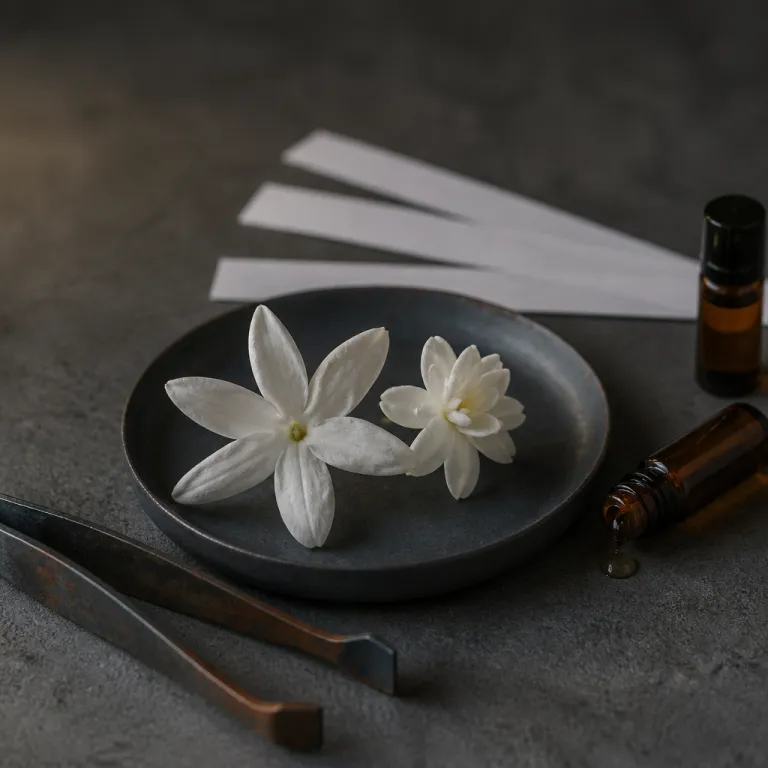
Jasmine as a middle note: one word, two different flowers
When a perfume lists jasmine in the heart, it rarely tells you which one. The quiet secret of jasmine perfume is that this single word hides two different Jasminum species, two distinct families of aroma, and two different emotional temperatures on skin. If you care about middle notes and how a fragrance blooms after the top, understanding this split changes how you read every bottle on your shelf.
On one side sits Jasminum grandiflorum, the classic French perfumery jasmine flower that shaped so many historic fragrances. Its aroma profile is opulent, honeyed, slightly animalic, with a narcotic warmth that wraps around rose, orange blossom and ylang as if they were relatives in the same family. On the other side stands Jasminum sambac, the jasmine of tea traditions, greener, more transparent, with a crisp warmth that feels like night air over wet jasmine flowers in a courtyard.
Perfumers talk about jasmine grandiflorum and jasmine sambac as if they were different instruments in the same orchestra. Grandiflorum absolute from India and from the historic fields of Grasse leans rich and velvety, while material from newer production routes can smell slightly drier, with a hay like nuance that anchors the middle notes. Sambac absolute, often sourced from India and Southeast Asia, brings a fresher, tea like fragrance that can feel almost dewy, especially when paired with green notes built around molecules such as cis-3-hexenol.
This article focuses on jasmine as a middle note, not as a vague floral blur. We will look at how jasmine absolute is extracted, why yields are low, and why jasmine absolutes remain among the most expensive natural materials in perfumery. Most importantly, we will translate the technical language of aroma chemistry, from benzyl acetate to methyl anthranilate, into what your nose actually experiences when you spray a jasmine centered perfume on your wrist.
Jasminum grandiflorum: the classic French jasmine in the heart
Jasminum grandiflorum is the species that underpins so many so called French floral fragrances. Its flowers open before dawn, and pickers in India and in the remaining plots of Grasse move quickly, because the aroma is most intense when the jasmine flower is still cool. Those fragile blossoms are rushed to extraction, since every hour lost means fewer aromatic molecules in the final grandiflorum absolute.
In the lab, the scent profile of Jasminum grandiflorum reads like a small poem of chemistry. Benzyl acetate gives that juicy, almost fruity floral lift that makes the flower feel alive, while indoles and other heavier notes add the faintly animalic shadow that makes a jasmine accord feel human rather than detergent clean. Methyl anthranilate contributes a grape like, honeyed warmth that links grandiflorum to orange blossom and other white flowers in the same olfactory family.
On skin, jasmine absolute from grandiflorum behaves like a slow unfurling silk scarf. The first minutes can feel bright and almost green, especially when perfumers support the natural oil with synthetic green notes such as cis-3-hexenol or with a touch of galbanum, but the heart quickly turns creamy, warm and slightly leathery. In many classic fragrances, a small amount of grandiflorum absolute or a carefully built jasmine oil accord sits in the middle, tying together citrus top notes and musky, woody bases.
Because yields are low, true grandiflorum absolute is expensive, which is why many modern compositions use a blend of jasmine absolute and carefully chosen synthetics. Industry guides and supplier data sheets often cite figures in the hundreds of thousands of jasmine flowers to produce a kilogram of absolute, and prices for high quality material can reach into the low thousands of dollars per kilo depending on harvest, origin and grade. A typical formula might pair a trace of natural jasmine flower extract with aroma chemicals that echo its facets, stretching the effect without losing the floral soul. When you read an article about luxury white floral fragrance, this is usually the jasmine they mean, even if the label simply says jasmine without mentioning Jasminum grandiflorum by name.
Grandiflorum–sambac blends are also increasingly common, where perfumers layer the richer grandiflorum absolute with the fresher sambac absolute to create a more three dimensional middle note. In such cases, the fragrance can move from green and tea like to honeyed and narcotic over several hours, giving the wearer the sense of walking through a garden as jasmine flowers open from afternoon to midnight. For lovers of nuanced floral notes, learning to recognize this evolution is one of the quiet pleasures of wearing jasmine focused compositions.
Jasminum grandiflorum also interacts beautifully with other white flowers, especially when perfumers want to echo the creamy facets of gardenia. If you are curious about how these white floral families overlap, a detailed exploration of the alluring aroma of gardenia shows how jasmine, tuberose and gardenia share certain lactonic and creamy notes while still remaining distinct. Understanding this shared language of flowers helps you read the middle notes of your favorite fragrances with far more precision.
Jasminum sambac: tea, night air and green warmth
Jasminum sambac lives in a different register from its grandiflorum cousin, even though both belong to the same jasmine family. Where grandiflorum leans honeyed and narcotic, jasmine sambac feels fresher, greener and more transparent, like a bowl of jasmine tea steaming beside an open window. The aroma sambac offers is still unmistakably floral, but the emphasis shifts from animalic warmth to crisp, almost dewy clarity.
In many parts of Asia, jasmine flower garlands and jasmine tea define the cultural image of the note, and those traditions center on Jasminum sambac rather than on grandiflorum. Perfumers who want to evoke tea ceremonies, humid gardens or night blooming jasmine flowers in courtyards will often reach for sambac absolute as their main essential oil material. This sambac extract carries a green, slightly fruity floral tone that sits beautifully beside citrus, green tea accords and even a touch of orange blossom in the heart.
On skin, a jasmine sambac focused fragrance often opens with a burst of green notes, sometimes supported by cis-3-hexenol or other leafy molecules to amplify that freshly crushed leaf effect. As the middle notes settle, the floral heart becomes creamier but rarely as animalic as Jasminum grandiflorum, making sambac a favorite for people who want a jasmine experience without the barnyard whisper some associate with classic French jasmine. The result is a middle note that feels luminous, almost transparent, yet still undeniably sensual.
Because sambac grows widely in India and across Southeast Asia, its supply chain looks different from that of grandiflorum, which historically centered on Grasse and on specific regions of Indian and Egyptian cultivation. Still, the extraction challenge remains similar, with low yields and a high number of jasmine flowers required to produce a small amount of sambac absolute. That scarcity is one reason why many so called tea jasmine fragrances rely on a blend of natural essential oil and synthetics rather than on pure jasmine absolute.
Jasminum sambac also plays well with other refined middle notes such as iris, especially in modern niche compositions that aim for a weightless yet textured heart. If you are fascinated by how these materials shape the center of a fragrance, a deep dive into why iris is considered the queen of the middle shows how jasmine sambac and orris can intertwine to create a sophisticated, powdery floral core. When perfumers balance sambac with iris, the result can feel like silk organza over cool skin, a contrast that rewards close attention.
Natural jasmine absolute, synthetics and the cost of a heart note
Both Jasminum grandiflorum and Jasminum sambac share one hard truth, which is that their natural extracts are costly and technically demanding to produce. To obtain jasmine absolute, producers typically use solvent extraction on fresh jasmine flowers, then wash the resulting concrete with alcohol to isolate the fragrant absolute. The yield is famously low, meaning that a large mass of jasmine flower material produces only a small quantity of usable oil.
This scarcity is why jasmine absolute and grandiflorum absolute sit among the most expensive floral materials in a perfumer’s palette. Depending on origin and quality, trade catalogues and specialist suppliers report prices for natural jasmine extracts ranging from several hundred to several thousand dollars per kilogram, putting them in the same cost bracket as orris butter and high grade rose absolute. A formula built entirely on natural jasmine absolutes would be prohibitively costly for most commercial fragrances, so perfumers rely on a sophisticated mix of natural and synthetic notes. Molecules such as benzyl acetate and methyl anthranilate, both naturally present in jasmine oil, are also produced synthetically to recreate and amplify specific facets of the aroma profile.
Green nuances in jasmine based compositions are often supported by cis-3-hexenol, a powerful molecule that smells like freshly cut grass and crushed leaves. Used in tiny amounts, cis-3-hexenol can make jasmine sambac feel more like jasmine tea, or can sharpen the leafy aspects of grandiflorum in a chypre style fragrance. When balanced carefully, these synthetics do not replace the jasmine flower so much as they frame it, allowing a small amount of natural essential oil to feel more expansive.
Perfumers also use entirely synthetic jasmine accords when budget or style demands a cleaner, more abstract floral heart. These accords might mimic the general fragrance of jasmine flowers without the indolic, animalic undertones that some wearers find challenging, resulting in a more laundry fresh floral. For the everyday fragrance lover, this means that the word jasmine on a box can signal anything from a rich, natural grandiflorum absolute to a minimalist, synthetic white floral built around benzyl acetate and related molecules.
Understanding this spectrum helps you read marketing language with a more critical nose. If a brand emphasizes natural jasmine absolute, jasmine grandiflorum or Jasminum sambac on the ingredient story, you can expect a more textured, sometimes slightly dirty floral heart. If the copy leans on words like clean, airy and transparent without mentioning absolute or essential oil, you are probably looking at a composition where synthetics carry most of the jasmine effect.
Middle notes are where these choices become most obvious, because that is where jasmine, iris, rose and other florals do the quiet structural work. For a broader view of how another workhorse material shapes the heart and base of modern fragrances, an in depth look at patchouli as a quiet workhorse shows how florals like jasmine sit atop deeper, earthier supports. Once you start paying attention to this architecture, the middle of a perfume becomes as interesting as the opening fireworks.
How perfumers choose between grandiflorum and sambac in real fragrances
When a perfumer sketches a new composition, the choice between jasmine grandiflorum and jasmine sambac is rarely arbitrary. Grandiflorum tends to be chosen for fragrances that aim for opulence, warmth and a slightly vintage floral character, especially when paired with rose, orange blossom and creamy white flowers. Sambac, by contrast, is the go to for modern, green, tea like hearts that feel more casual, often sitting beside citrus, green tea accords and transparent musks.
Imagine a rich floral chypre with mossy base notes and a plush rose heart. In that context, Jasminum grandiflorum or a carefully constructed grandiflorum–sambac blend will usually provide the necessary depth, with the absolute adding a honeyed, almost leathery nuance that anchors the middle. A lighter cologne style fragrance built around jasmine tea, citrus and soft woods will more likely lean on Jasminum sambac, using sambac absolute and supporting green notes such as cis-3-hexenol to keep the heart bright.
Perfumers also consider cultural associations when choosing their jasmine flower. For a fragrance inspired by Grasse or by classic haute parfumerie, jasmine grandiflorum and grandiflorum absolute feel historically appropriate, echoing the fields that supplied so many iconic compositions. For scents referencing India, Southeast Asia or jasmine tea rituals, Jasminum sambac and sambac based accords make more narrative sense, especially when combined with spices, sandalwood or incense.
Budget and brand positioning play a role as well, since natural jasmine absolute from either species is costly. A luxury extrait might justify a higher dose of jasmine absolute, while an accessible eau de toilette could rely on a smaller amount of essential oil supported by synthetics such as benzyl acetate and methyl anthranilate. In both cases, the perfumer is balancing cost, performance and the desired emotional impact of the middle notes.
For the wearer, learning to sense these differences turns shopping into a more informed pleasure. If you prefer your floral fragrances creamy, honeyed and slightly animalic, you are probably a grandiflorum person, and you can look for mentions of jasmine grandiflorum, Jasminum grandiflorum or grandiflorum–sambac blends in the brand’s article or product description. If you gravitate toward green, tea like, almost airy florals, your nose is likely choosing jasmine sambac, Jasminum sambac and sambac absolute whenever the option appears.
Over time, you may even notice that certain families of fragrance lean consistently toward one jasmine or the other. Many white floral bouquets with tuberose and orange blossom favor grandiflorum for its narcotic richness, while so called tea florals and modern musky skinscents often rely on sambac for its transparent, green floral lift. Paying attention to these patterns helps you predict how a jasmine heart will behave on your skin long before the first spray.
Reading “jasmine” on a label: what your nose is really choosing
Standing at a perfume counter, you often see only the single word jasmine in the note pyramid. Behind that simplicity lies a choice between Jasminum grandiflorum, Jasminum sambac, a blend of both, or a fully synthetic jasmine accord that merely gestures toward jasmine flowers. Your task as a fragrance lover is not to decode every formula, but to learn how each option tends to smell so you can align your nose with what the label is quietly promising.
If the fragrance is described as opulent, vintage inspired or narcotic, and if it sits in a floral, floral oriental or chypre family, you can reasonably expect jasmine grandiflorum or a grandiflorum–sambac mix in the middle notes. Look for language about jasmine absolute, grandiflorum absolute or natural jasmine oil, which signals that at least some true jasmine flower extract is present alongside synthetics such as benzyl acetate and methyl anthranilate. When the copy leans on words like tea, green, airy and luminous, jasmine sambac and Jasminum sambac accords are usually doing the heavy lifting.
Your own skin chemistry will also shape how jasmine materials behave. On some people, the animalic facets of grandiflorum absolute bloom strongly, making the fragrance feel warmer and more sensual, while on others the same notes stay relatively soft and honeyed. Sambac absolute can read as sparkling and green floral on one wrist, yet almost creamy and tropical on another, especially when paired with orange blossom or other white flowers.
Sampling on skin rather than on paper strips is essential when jasmine sits at the heart of a composition. Because jasmine is a classic middle note, it often takes fifteen to thirty minutes for the full aroma profile to emerge, especially in complex fragrances where top notes of citrus, herbs or aldehydes need time to fade. Give the perfume at least an hour before judging, and pay attention to how the jasmine flower impression shifts from green to creamy, from tea like to honeyed, as the essential oil and synthetics settle.
Over time, you will build a mental library of how different jasmines behave in different contexts. You might notice that you love jasmine absolutes in winter, when their warmth feels comforting, but prefer lighter jasmine sambac tea style fragrances in summer heat. You may also find that certain combinations, such as jasmine flower with patchouli or jasmine with incense, become personal signatures that you seek out across brands.
What lingers at midnight is not the marketing story but the quiet trace of jasmine on your wrist. Whether that trace comes from Jasminum grandiflorum, Jasminum sambac or a carefully built synthetic accord, your nose is always choosing between different interpretations of the same flower. Learning to name those choices is less about jargon and more about paying attention to what the middle of a fragrance is really saying to you.
FAQ
How can I tell if a perfume uses jasmine grandiflorum or jasmine sambac ?
Most brands do not list the exact species, but the style of the fragrance offers clues. Rich, honeyed, slightly animalic florals that feel classic usually rely on jasmine grandiflorum, while greener, tea like, more transparent florals tend to use jasmine sambac. Reading the note list for mentions of jasmine absolute, grandiflorum absolute or sambac absolute can also hint at which jasmine flower is in the formula.
Why is natural jasmine absolute so expensive in perfumery ?
Natural jasmine absolute is costly because the yield from fresh jasmine flowers is very low, and harvesting is labor intensive. Thousands of blossoms of Jasminum grandiflorum or Jasminum sambac are needed to produce a small amount of absolute, and they must be picked quickly before the aroma fades. This combination of low yield, delicate handling and high demand keeps the price of jasmine absolute and grandiflorum absolute among the highest for floral materials.
Do synthetic jasmine notes smell fake compared with natural jasmine flowers ?
Synthetic jasmine notes can smell very convincing, because many of them, such as benzyl acetate and methyl anthranilate, are identical to molecules found in natural jasmine oil. What they often lack is the subtle complexity and micro variations that come from a full spectrum jasmine absolute. Many modern fragrances therefore blend a small amount of natural essential oil with synthetics to balance realism, cost and consistency.
Is jasmine more of a feminine note, or can men wear jasmine centered fragrances ?
Jasmine is traditionally marketed as feminine in Western perfumery, especially when paired with other white flowers and sweet notes. In practice, both jasmine grandiflorum and jasmine sambac appear in many so called masculine fragrances, often hidden behind woods, spices and green accords. If you enjoy the aroma jasmine brings to a composition, there is no reason to treat it as gendered, especially in modern niche and artisanal fragrances.
Why do some jasmine perfumes smell indolic or animalic on my skin ?
The indolic, animalic nuance in some jasmine based compositions comes mainly from molecules naturally present in Jasminum grandiflorum absolute. On certain skin types, these notes can bloom more strongly, making the fragrance feel dirtier or more sensual than on a blotter. If you find this effect overwhelming, you may prefer jasmine sambac or tea style jasmine fragrances, which usually emphasize greener, cleaner floral facets.